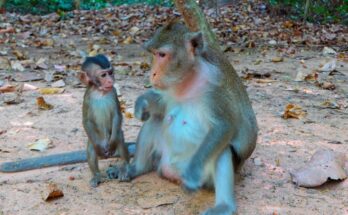
Poor Dolly sat alone in quiet pain, her body weak and exhausted, her eyes heavy with suffering. The forest around her moved as usual, but she remained still, as if every movement hurt. Giving birth had drained her completely. She had no strength left to cry, no energy to search, only enough will to stay alive. Watching her like this was heartbreaking—she was a mother in pain, alone with her struggle.
From a documentary perspective, post-birth exhaustion in wildlife can be life-threatening. A mother monkey must recover quickly to care for her newborn, but when nutrition is low and the body is already weak, recovery becomes slow and painful. Dolly’s condition showed clear signs of this reality. Her posture was slumped, her breathing shallow, her movements minimal. She was not resting in comfort—she was enduring.
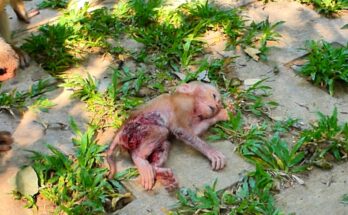
Nearby, baby Dalton had already suffered hunger and weakness of his own. After receiving some extra milk, his tiny body began to respond. His breathing steadied, his small limbs moved with slightly more strength, and his eyes opened wider. That milk was not just food—it was hope. But even with nourishment, Dalton needed the one thing only a mother could give: closeness.
Carefully, gently, we caught Dalton and softly brought him near his mom.
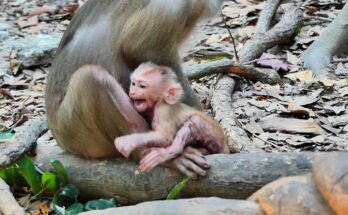
Emotionally, this moment was overwhelming. Dalton made small sounds as he was moved, not cries of fear, but soft calls—instinctively searching for Dolly. When he was placed near her, the air seemed to change. Dolly lifted her head slowly, noticing the tiny body beside her. In her tired eyes, there was recognition. Pain, exhaustion, and instinct met in a single moment.
Dolly did not move quickly. She could not. But she leaned closer, sniffing Dalton, touching him gently with weak hands. This simple contact spoke louder than any sound. It showed that her love had never disappeared—it had only been buried under pain and weakness. The bond was still there, fragile but real.
From a behavioral viewpoint, reuniting a newborn with its mother must be done carefully. Stress can overwhelm both. But when done gently, it can restore natural instincts. Dolly’s slow response was a sign of recovery beginning—not just physical, but emotional. She was no longer completely alone.
Dalton pressed closer, seeking warmth. His body curled naturally toward his mother, trusting her again. That trust, after everything he had endured, was deeply moving. It reminded us how powerful instinct is, even in the weakest moments.
The forest remained quiet, as if respecting the reunion. Leaves rustled softly, birds called in the distance, and time seemed to slow. This was not a miracle—this was effort, care, and compassion meeting nature halfway.
Poor Dolly was still in pain. Dalton was still weak. Their future was uncertain. But in that moment, something precious returned: connection. Mother and baby were together again.
This story is a reminder that wildlife survival is not always about strength—it is about timing, care, and small acts that make a difference. Bringing Dalton back to Dolly was not just a rescue step; it was a moment of healing.
In the harsh world of the wild, even the smallest gentle act can bring light into deep suffering. And for Dolly and Dalton, that gentle reunion offered something priceless—hope.